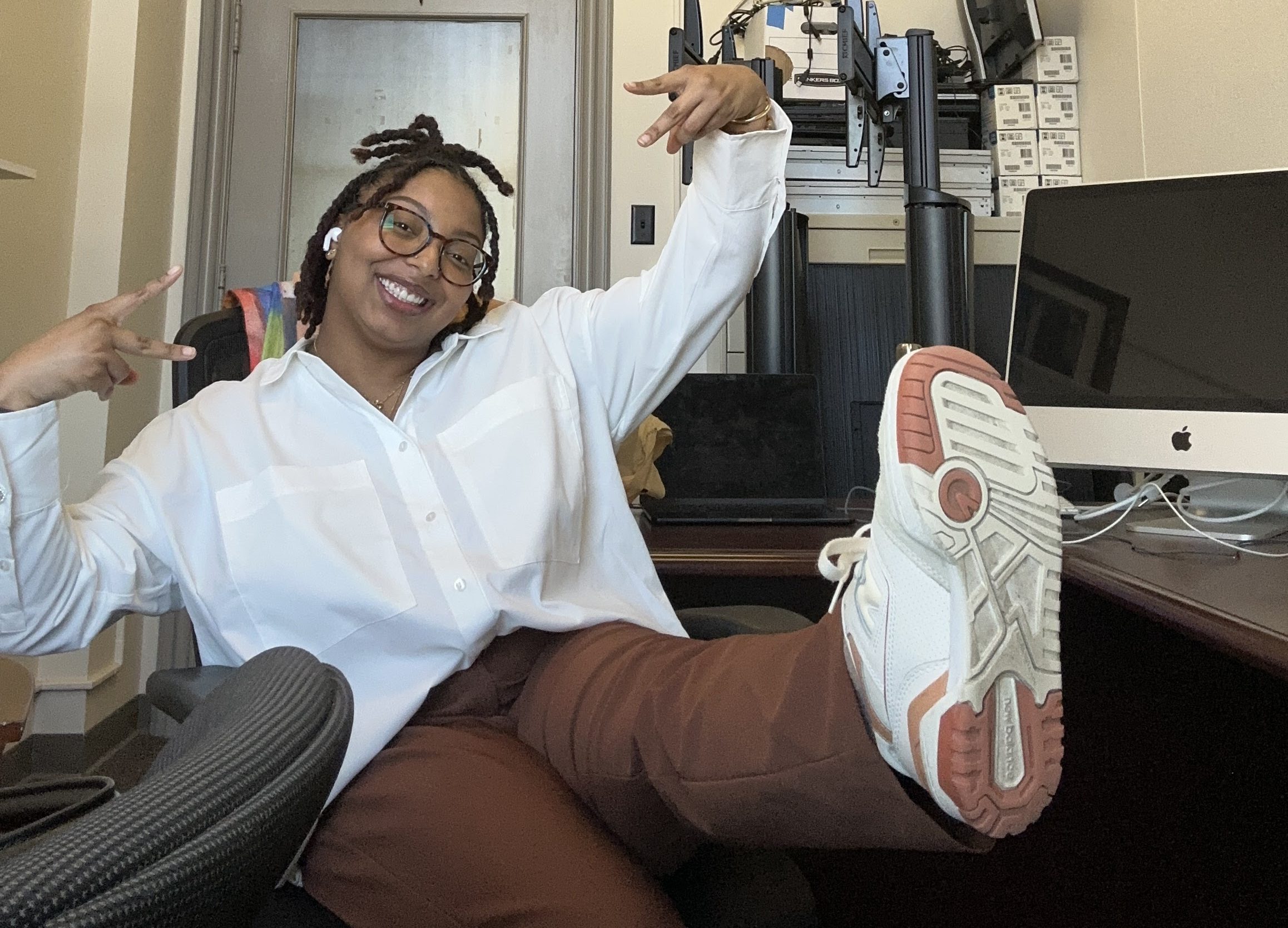
How am I supposed to speak if not of myself?
The above quote is from an interview that I did with some very wonderful students for a podcast back in 2020, but it still rings true for me. I don’t have the answer. The answer to that question has plagued me for most of my adult life. I used to see Black language as something wrong and a way of speaking that should not be used outside of the home. I was ashamed of some of the ways I would speak that came naturally to me. Throughout my research tenure, I have been exposed to ways of thinking about how I speak that served as catalysts to wanting to rally behind the idea that my Lexicon was not only valid but should be studied and celebrated. I’m thinking of books like: Dr. Tracey Weldon’s Middle-Class African American English, The Oxford Handbook of African American Language, edited by Dr. Sonja Lanehart, Talkin’ and Testifyin’ by Dr. Geneva Smitherman, and Roc the Mic Right by Dr. H. Samy Alim, just to name a few. (If you want a book list, I will certainly provide one to you.)
Lexicon & Legacy is the result of a mindset shift in how I look at what I study and some of my core beliefs about Black language, identity, creativity, and how I can leave my mark on the world–my Legacy. If you don’t know, my dissertation deals with developing a roadmap of how to study Black language, identity, and creativity in Rap music lyrics from an interdisciplinary lens, centering on sociolinguistics. I know one part of my mark will be the work I continue to champion here, which is why I wanted to shift from my little microcosm of work to create a space where we can all do some introspective work to understand our attitudes and the world around us.
What “Lexicon” Represents
Lexicon (ˈleksəˌkän noun): a vocabulary of a person, language or branch of knowledge
So, I decided to put the above definition of what lexicon means. This also stems from the idea of Lexycal, my brainchild for this work. Lexycal means “of or related to the words or vocabulary in a language”; of or related to the many facets of Dr. Lexy. So, the Lexicon is and has always been my focus. In the context of what I study, currently, I am an expert on Black language usage in Rap music lyrics to shape identity and be a lens into Black creativity.
“Rap is a rich cultural and linguistic art form.” (Brown, 2024)
The above quote is from my dissertation and serves as the backbone of my work. Language is central to culture, creativity, and representation. Rap being a “rich cultural art form” means that the lyrical content and traditions presented in Rap music convey information about Black Americans’ lived experiences and culture to the broader public, including global audiences. Rap is a “rich linguistic art form” since it primarily utilizes the African American Language (AAL) in varied and creative ways. It offers much to the discourse of language variation and sociocultural expression of self.
What “Legacy” Represents
Legacy (ˈlegəsē noun): the long-lasting impact of particular events, actions, etc. that took place in the past, or of a person’s life.
Legacy is more than what we leave behind—it is what we carry forward. In studying Black language and identity, I see legacy in the ways Black people have preserved, innovated, and reshaped language across generations, often in the face of systemic erasure. Hip Hop, as both a cultural movement and linguistic archive, embodies this continuity. The genre is rooted in the oral traditions of the African diaspora, where storytelling, rhythm, and linguistic fluency merge to create a living history.
My dissertation answered Geneva Smitherman’s call in Roc the Mic Right to continue proving the value of Hip Hop culture in all its forms and to uncover “the truth about the language of our people” (Alim, 2008, p. vii). As a scholar of sociolinguistics, I approach Rap not just as entertainment, but as a site of linguistic and cultural innovation. Its creative process—from rhyme structures to rhythmic complexity—mirrors Black oral traditions and affirms Black linguistic identity. Even sampling, a foundational practice in Rap, reflects deeper cultural legacies, recalling African-derived practices of call-and-response, intertextuality, and communal storytelling.
Smitherman (1997) describes the rapper as a “postmodern African griot,” a verbally gifted storyteller responsible for speaking truth and carrying cultural history forward (p. 4). In many ways, this resonates with my own journey as a Black woman PhD holder, scholar, and entrepreneur. My work is about more than documenting Black language—it is about affirming its place in academia, media, and the broader cultural landscape. Through my research, business, and blog, I seek to shape conversations that elevate Black linguistic legacy, ensuring that our voices, creativity, and truths are recognized, respected, and remembered.
Bridging the Two: Why This Name?
The decision to name this blog Lexicon & Legacy was intentional—a reflection of both my scholarly journey and my commitment to Black language and identity. The words we speak, the stories we tell, and the linguistic choices we make are never just about communication; they are about culture, history, and power. Lexicon represents my dedication to studying, documenting, and celebrating Black language, particularly through the lens of Hip Hop and African American Language. Legacy represents the impact I hope to leave, not just as a scholar, but as a Black woman shaping conversations about language, identity, and creativity.
This blog is an extension of my research, but more importantly, it is a space for critical dialogue and reflection. It is about moving beyond academia’s traditional boundaries to engage with the lived realities of Black linguistic expression. My work is rooted in interdisciplinary study, but the real-world implications of Black language, from Rap music to everyday communication, deserve a broader audience. By merging Lexicon and Legacy, I hope to create a space where language is not just analyzed but honored, where scholarship meets culture, and where our voices are amplified on our own terms.
Conclusion
At its core, Lexicon & Legacy is about the intersection of language, culture, and impact. It is about recognizing the power of Black linguistic traditions, both historical and contemporary, and understanding how they shape identity, creativity, and social change. It is also about my own journey—one that has taken me from questioning the validity of my own language to becoming a scholar who champions its significance.
This blog is not just about my voice; it is about our voices. It is an invitation to engage, reflect, and celebrate the beauty and complexity of Black language and identity. I want to challenge the narratives that have marginalized our speech and highlight how we continue to innovate and inspire.
So, I leave you with this question:
What words and stories define your legacy?
Let’s explore them together.
 ALEXUS P. BROWN, PH.D.